

Protein Condiments Market to Reach USD 7.2 Billion by 2036, at 14.9% CAGR Driven by Obesity-Led Nutrition Reformulation
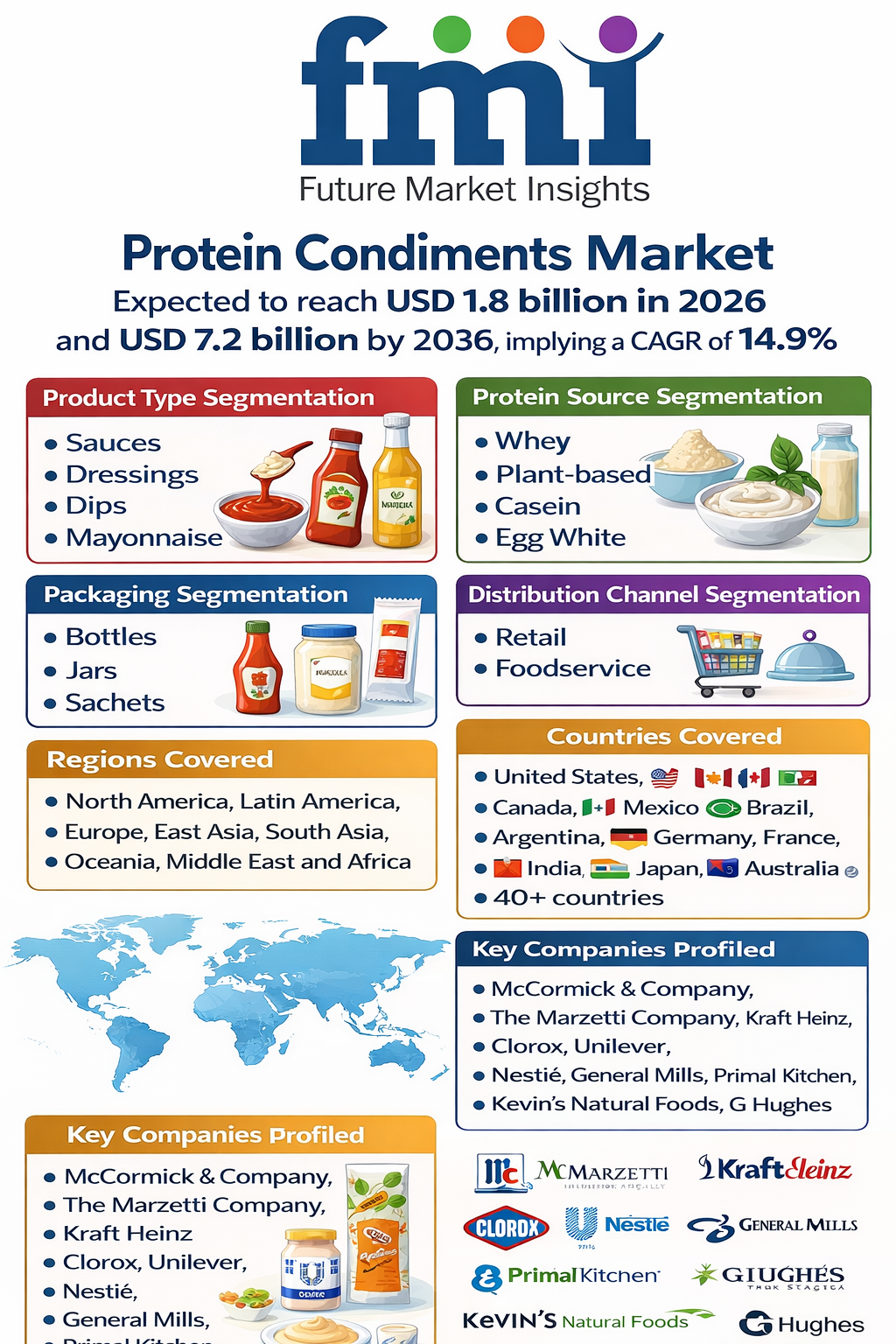
Protein Condiments Market
Protein Condiments Market report highlights rising demand for protein-fortified sauces and dressings as condiments evolve into functional nutrition solutions.
NEWARK, DE, UNITED STATES, February 24, 2026 /EINPresswire.com/ -- The global protein condiments market is undergoing a structural transformation as consumers increasingly demand functional nutrition embedded within everyday meal components. Valued at USD 1.6 billion in 2025, the market is estimated to reach USD 1.8 billion in 2026 and is projected to surge to USD 7.2 billion by 2036, expanding at a robust CAGR of 14.9%. An absolute dollar opportunity of USD 5.4 billion over the decade reflects a paradigm shift from flavor-only condiments to protein-fortified functional additions.
This acceleration is fundamentally linked to mounting global health pressures. With 1 in 8 people worldwide affected by obesity and 2.5 billion adults classified as overweight in 2022, regulators and retailers are actively favoring nutrient-dense formulations. Condiment manufacturers are responding by replacing empty calories with functional proteins, repositioning sauces and dressings as tools for satiety, muscle maintenance, and metabolic balance.
Request For Sample Report | Customize Report | Purchase Full Report - https://www.futuremarketinsights.com/reports/sample/rep-gb-32082
Market Summary: Protein Condiments
Definition
Condiments fortified with protein ingredients (whey, pea, soy, egg white, casein) to deliver functional nutrition alongside flavor enhancement.
Market Size & Growth Outlook (Bullet Table Format)
• Market Value (2025): USD 1.6 Billion
• Estimated Value (2026): USD 1.8 Billion
• Forecast Value (2036): USD 7.2 Billion
• Projected CAGR (2026–2036): 14.9%
• Absolute Dollar Growth: USD 5.4 Billion
• Primary Growth Factor: Rising obesity rates driving demand for satiating, nutrient-dense food formats
Structural Demand Drivers
• Rising global obesity prevalence forcing reformulation of calorie-dense additives
• Mainstream consumer intent to increase daily protein intake
• Innovation in emulsion and solubility technologies improving mouthfeel
• Growth of flexitarian and “meat reducer” demographics
• Regulatory push toward improved macronutrient transparency
According to FMI’s Principal Consultant for Food & Beverage, Nandini Roy Choudhury, “The ‘sauce-ification’ of nutrition is unlocking mass adoption. Embedding protein into familiar formats like ranch or barbecue sauce captures consumers who refuse to compromise on taste but demand improved macronutrient profiles.”
Segmental Insights
By Product Type
• Sauces: 42.8% market share (dominant segment)
• Dressings: Fastest growing at 17.3% CAGR
• Dips & Spreads: Expanding through snackification trend
Sauces dominate due to bold flavor systems capable of masking plant protein notes. Dressings are accelerating as salads remain core meals for health-conscious consumers seeking satiety rather than empty calories.
By Protein Source
• Plant-Based Proteins: 18.2% CAGR (fastest growing)
• Animal-Based Proteins: Stable growth via whey and casein fortification
Improved dispersibility of pea and soy proteins has resolved historical texture barriers in liquid emulsions, enabling smoother vegan formulations.
Market Scope Clarification
Inclusions
The scope of the protein condiments market includes shelf-stable as well as refrigerated protein-fortified sauces designed to deliver functional nutrition alongside flavor.
It covers high-protein mayonnaise and protein-enriched salad dressings positioned for health-conscious consumers seeking improved macronutrient profiles.
Greek yogurt-based savory dips and spreads formulated for satiety and functional snacking are also included within the analysis.
Vegan and plant-based protein-enhanced condiments using pea, soy, rice, or other alternative proteins form a significant part of the market scope.
Exclusions
The market scope excludes standard condiments that contain only naturally occurring trace protein unless they are explicitly marketed as “protein-fortified” or “high-protein.”
Meal replacement powders, protein shakes, and standalone nutritional beverages fall outside the defined category.
Plain dairy staples such as regular Greek yogurt or cottage cheese are also excluded unless specifically formulated, positioned, and packaged as protein-fortified savory dips or condiment-style spreads.
Regional Growth Landscape
Top Country CAGR Comparison (Bullet Table Format)
• China: 18.9%
• India: 17.4%
• United States: 16.2%
• United Kingdom: 14.8%
• Germany: 13.6%
• Japan: 12.7%
• Australia: 11.9%
Asia Pacific leads global growth, fueled by rapid urbanization and demand for convenient protein supplementation. China’s expansion reflects scaling of stealth-nutrition sauces across ready-meal platforms. India benefits from vegetarian dietary patterns seeking protein enhancement through familiar chutneys and creamy sauces.
North America remains the innovation hub, driven by high consumer awareness of protein intake and strong plant-based retail ecosystems. Europe emphasizes clean-label integration and organic positioning within protein-enhanced staples.
Competitive Landscape
The market is marked by aggressive platform consolidation and cross-category collaboration. Major players include:
• McCormick & Company
• The Marzetti Company (Lancaster Colony)
• Kraft Heinz
• Clorox (Hidden Valley Ranch)
• Unilever (Hellmann’s)
• Nestlé
• General Mills
• Primal Kitchen
• Kevin’s Natural Foods
• G Hughes
Industry expansion is reinforced by acquisitions and strategic consolidation initiatives. Investment in ingredient technology—particularly high-dispersibility plant proteins—is becoming a key differentiator.
Outlook: From Flavor Enhancer to Functional Anchor
The protein condiments market represents one of the most dynamic intersections of health reformulation and everyday consumption. By 2036, protein-fortified sauces and dressings are expected to transition from niche functional offerings to mainstream pantry essentials.
As obesity-driven dietary reform intensifies and consumers increasingly seek “stealth health” solutions, condiments are emerging not merely as accompaniments—but as strategic macronutrient delivery systems embedded seamlessly into daily meals.
Browse Related Insights
Protein/Antibody Engineering Market: https://www.futuremarketinsights.com/reports/advances-protein-antibody-engineering-market
Protein A Resins Market: https://www.futuremarketinsights.com/reports/protein-a-resins-market
Protein Flavor Masking Agents Market: https://www.futuremarketinsights.com/reports/protein-flavor-masking-agents-market
About Future Market Insights (FMI)
Future Market Insights, Inc. (FMI) is an ESOMAR-certified, ISO 9001:2015 market research and consulting organization, trusted by Fortune 500 clients and global enterprises. With operations in the U.S., UK, India, and Dubai, FMI provides data-backed insights and strategic intelligence across 30+ industries and 1200 markets worldwide.
Sudip Saha
Future Market Insights Inc.
+ +1 347-918-3531
email us here
Legal Disclaimer:
EIN Presswire provides this news content "as is" without warranty of any kind. We do not accept any responsibility or liability for the accuracy, content, images, videos, licenses, completeness, legality, or reliability of the information contained in this article. If you have any complaints or copyright issues related to this article, kindly contact the author above.
