

Electric Bus Market 2026 Sustainable Public Transportation Driving Industry Growth
Electric Bus Market Report 2026_Segments

Electric Bus Global Market Report 2026_Drivers
Electric Bus Market Report 2026_Regions
The Business Research Company's Electric Bus Market Report 2026 – Market Size, Trends, And Global Forecast 2026-2035
LONDON, GREATER LONDON, UNITED KINGDOM, March 17, 2026 /EINPresswire.com/ -- "Electric Bus Market to Surpass $26 billion in 2030. Within the broader Transport industry, which is expected to be $9,400 billion by 2030, the Electric Bus market is estimated to account for nearly 0.3% of the total market value.
Which Will Be the Biggest Region in the Electric Bus Market in 2030?
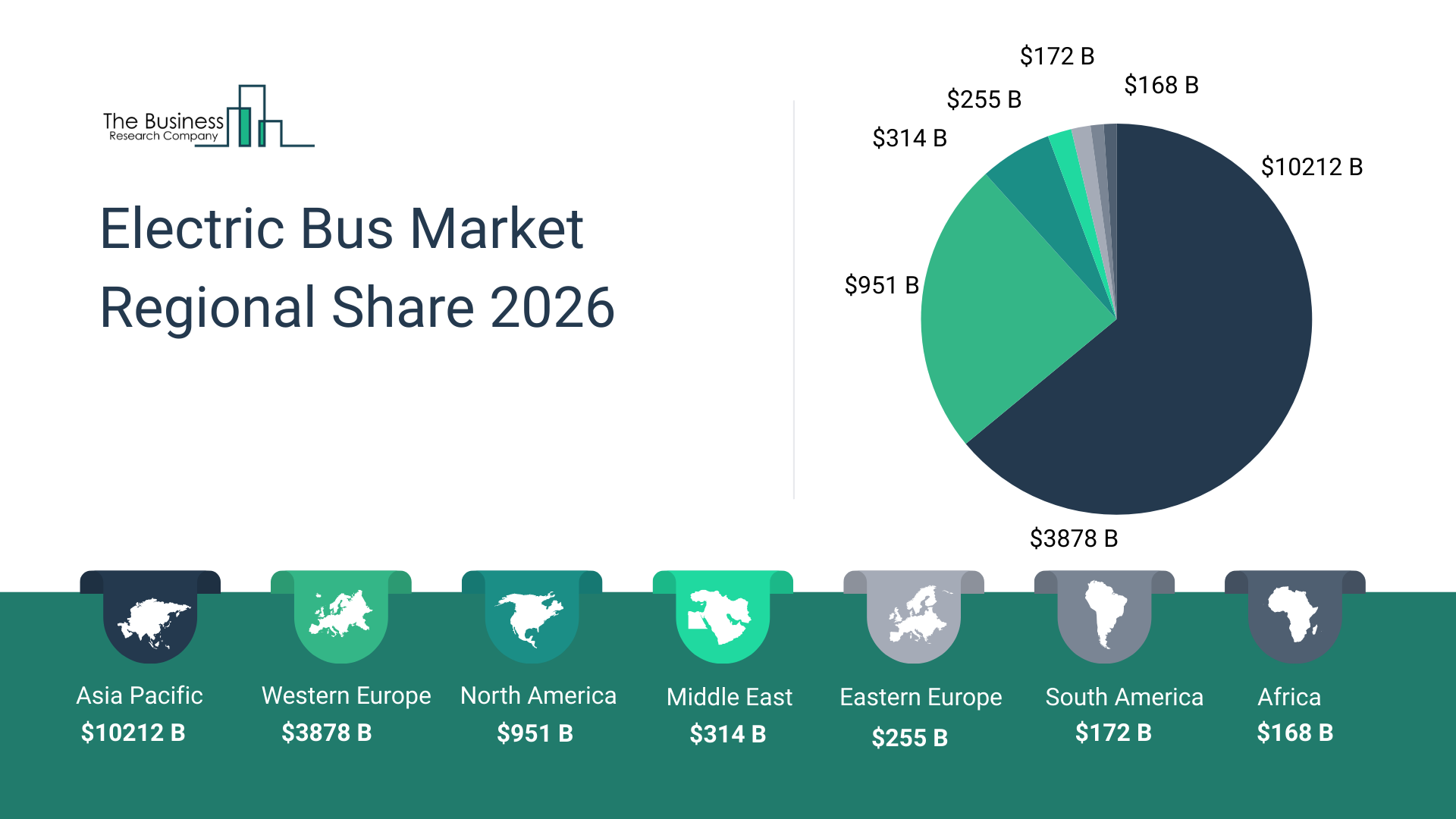
Asia Pacific will be the largest region in the electric bus market in 2030, valued at $16,324 million. The market is expected to grow from $9,107 million in 2025 at a compound annual growth rate (CAGR) of 12%. The rapid growth can be attributed to the corporate and municipal net-zero commitments and favorable government initiatives.
Which Will Be The Largest Country In The Global Electric Bus Market In 2030?
China will be the largest country in the electric bus market in 2030, valued at $10,822 million. The market is expected to grow from $7,732 million in 2025 at a compound annual growth rate (CAGR) of 7%. The strong growth can be attributed to the rising global public transit spending and expansion of charging infrastructure.
Request a free sample of the Electric Bus Market report:
https://www.thebusinessresearchcompany.com/sample_request?id=6402&type=smp&utm_source=EINPresswire&utm_medium=Paid&utm_campaign=Mar_PR
What will be Largest Segment in the Electric Bus Market in 2030?
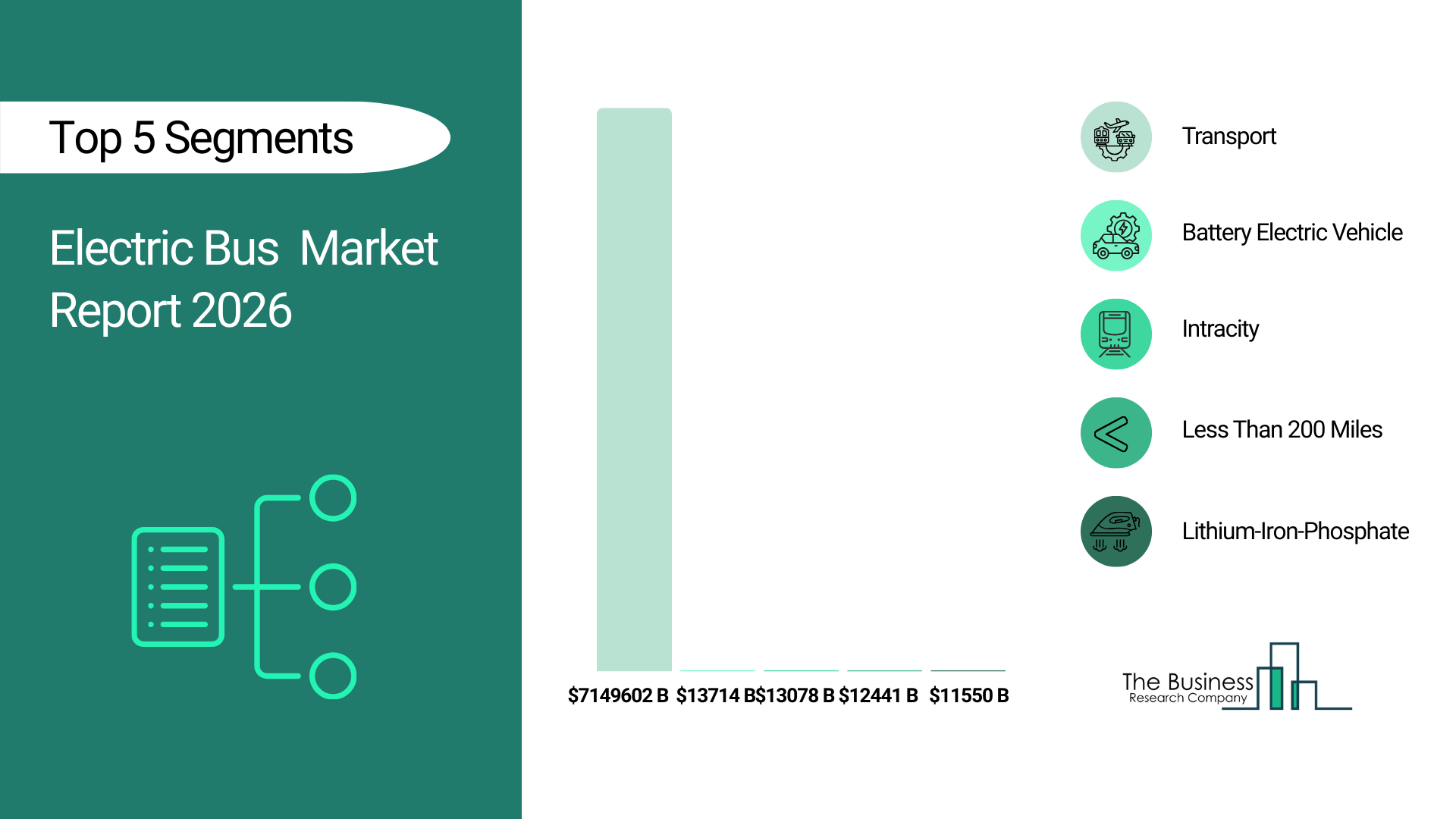
The electric bus market is segmented by type into battery electric vehicle, plug-in hybrid electric vehicle and fuel cell electric vehicle. The battery electric vehicle market will be the largest segment of the electric bus market segmented by type, accounting for 89% or $23,141 million of the total in 2030. The battery electric vehicle market will be supported by zero tailpipe emissions aligning with urban clean-air mandates, lower operating and fuel costs compared to diesel alternatives, strong suitability for fixed-route public transport operations, availability of public funding and subsidies for fully electric fleets, growing emphasis on noise reduction in dense cities, reduced maintenance due to fewer moving parts and increasing deployment in government-led public transit programs.
The electric bus market is segmented by battery type into lithium-nickel-manganese-cobalt-oxide, lithium-iron-phosphate and other battery types. The lithium-iron-phosphate market will be the largest segment of the electric bus market segmented by battery type, accounting for 80% or $20,920 million of the total in 2030. The lithium-iron-phosphate market will be supported by longer cycle life supporting intensive daily operations, enhanced thermal stability improving safety, lower total cost of ownership over the vehicle lifecycle, suitability for intracity stop-and-go traffic, growing preference among public transport agencies, reduced reliance on expensive raw materials and strong alignment with cost-sensitive mass transit projects. LFP batteries offer long cycle life, high thermal stability and strong resistance to overheating, which is critical for large fleets operating continuously in dense urban environments. Their lower reliance on expensive and volatile raw materials such as cobalt and nickel keeps upfront and replacement costs more predictable for transit authorities. Lithium-iron-phosphate is forecast to dominate and grow faster, reflecting its lower cost, safety, and longevity advantages for commercial vehicles, while NMC growth stalls.
The electric bus market is segmented by vehicle range into less than 200 miles and above 200 miles. The less than 200 miles market will be the largest segment of the electric bus market segmented by vehicle range, accounting for 76% or $19,683 million of the total in 2030. The less than 200 miles market will be supported by dominance of short-distance urban routes, predictable daily travel patterns, ease of overnight depot charging, lower battery costs reducing vehicle prices, suitability for intracity public transport systems, high frequency of stops supporting regenerative braking benefits and strong adoption by municipal transport authorities. Most city buses run on fixed routes with daily distances well below this threshold, allowing operators to complete full service schedules with a single overnight charge or limited opportunity charging. Buses in this range class require smaller battery packs, which lowers vehicle cost, reduces weight and improves energy efficiency while easing pressure on charging infrastructure.
The electric bus market is segmented by battery capacity into upto 400 kWh and above 400 kWh. The upto 400 kWh market will be the largest segment of the electric bus market segmented by battery capacity, accounting for 67% or $17,546 million of the total in 2030. The upto 400 kWh market will be supported by cost-effective battery sizing for urban operations, reduced vehicle weight improving efficiency, compatibility with standard depot charging infrastructure, widespread use in intracity fleets, easier thermal management, faster charging times and alignment with budget-constrained public transport procurements. Battery packs within this capacity are sufficient to support daily urban and suburban duty cycles, including stop-and-go traffic and auxiliary power needs, without adding excessive weight or cost. Smaller batteries reduce energy losses, charging time and strain on charging infrastructure, while also improving passenger capacity and vehicle lifespan.
The electric bus market is segmented by application into intercity and intracity. The intracity market will be the largest segment of the electric bus market segmented by application, accounting for 87% or $22,492 million of the total in 2030. The intracity market will be supported by strong push to reduce urban air pollution, large-scale public transport electrification programs, high daily passenger volumes, suitability for fixed routes and schedules, municipal funding and tenders, need for low-noise transportation in dense areas and integration with smart city and sustainable mobility plans. City routes typically involve short to medium daily distances, frequent stops and predictable schedules, which suit electric drivetrains that deliver high efficiency in stop-and-go traffic through regenerative braking. Municipal authorities also prioritize electrifying city fleets to reduce urban air pollution, noise levels and operating costs, while leveraging centralized depots for overnight charging. Intracity buses are the dominant and faster-growing segment, as urban decarbonization policies and lower daily range requirements make them the primary target for initial electrification.
What is the expected CAGR for the Electric Bus Market leading up to 2030?
The expected CAGR for the electric bus market leading up to 2030 is 13%.
What Will Be The Growth Driving Factors In The Global Electric Bus Market In The Forecast Period?
The rapid growth of the global electric bus market leading up to 2030 will be driven by the following key factors that are expected to reshape public-transport procurement, charging systems, battery manufacturing, fleet maintenance, and urban policy and operations worldwide.
Expansion Of Charging Infrastructure - The expansion of charging infrastructure will become a key driver of growth in the electric bus market by 2030. As charging availability improves at depots and along transit corridors, fleet operators will gain greater confidence in adopting electric buses without compromising route reliability or service frequency. This improved operational readiness will translate into stronger demand for electric bus models with varied battery capacities and charging compatibility, encouraging manufacturers to expand their product portfolios. While charging infrastructure itself lies outside the vehicle market, its growth directly supports higher electric bus procurement by enabling smoother integration of electric buses into daily transit operations. As a result, expansion of charging infrastructure is anticipated to contributing to a 3.0% annual growth in the market.
Rising Global Public Transit Spending - The rising global public transit spending will emerge as a major factor driving the expansion of the electric bus market by 2030. As governments and transport authorities allocate higher budgets to improve public transportation systems, electric buses are likely to be prioritized due to their alignment with sustainability and long-term cost-efficiency goals. Increased funding will support larger procurement programs, providing manufacturers with greater order volumes and encouraging scale production of electric bus platforms. This sustained capital flow into public transit will strengthen demand for battery electric, plug-in hybrid and fuel cell electric buses, supporting continued market expansion. Consequently, the rising global public transit spending is projected to contributing to a 2.8% annual growth in the market.
Stringent Zero Emission Mandates And Regulations - The stringent zero emission mandates and regulations will serve as a key growth catalyst for the electric bus market by 2030. As compliance requirements tighten, transit agencies and fleet operators will be compelled to transition toward zero-emission vehicle options, directly increasing demand for electric buses. These regulations will accelerate procurement timelines, shorten replacement cycles for conventional buses and push manufacturers to rapidly scale compliant electric bus offerings. Over time, regulatory pressure will reinforce electric buses as the default choice for new fleet additions, strengthening long-term market growth. Therefore, this stringent zero emission mandates and regulations is projected to supporting to a 2.5% annual growth in the market.
Corporate And Municipal Net-Zero Commitments - The corporate and municipal net-zero commitments will become a significant driver contributing to the growth of electric bus market by 2030. As cities, industrial operators and large institutions commit to carbon neutrality, electric buses will become a key tool for reducing emissions from passenger transport operations. These commitments will influence purchasing decisions, favoring electric bus platforms that support measurable emission reductions and long-term sustainability objectives. For manufacturers, this shift will translate into consistent demand from both public and corporate buyers seeking zero-emission bus solutions, further accelerating adoption and commercialization of electric buses across diverse applications. Consequently, the corporate and municipal net-zero commitments is projected to contributing to a 2.4% annual growth in the market.
Access the detailed Electric Bus Market report here:
https://www.thebusinessresearchcompany.com/report/electric-bus-global-market-report?utm_source=EINPresswire&utm_medium=Paid&utm_campaign=Mar_PR
What Are The Key Growth Opportunities In The Electric Bus Market in 2030?
The most significant growth opportunities are anticipated in the battery electric bus market, the intracity electric bus market, the lithium-iron-phosphate electric bus market, the electric bus for less than 200 miles market, and the electric bus for upto 400 kWh market. Collectively, these segments are projected to contribute over $49 billion in market value by 2030, driven by government electrification mandates, expansion of urban public transport electrification programs, declining battery costs, and improvements in charging infrastructure and operational efficiency. This surge reflects the accelerating transition toward zero-emission public mobility and fleet decarbonization initiatives, fueling transformative growth within the broader electric bus industry.
The battery electric bus market is projected to grow by $11,095 million, the intracity electric bus market by $11,052 million, the lithium-iron-phosphate electric bus market by $11,001 million, the electric bus for less than 200 miles market by $8,572 million, and the electric bus for upto 400 kWh market by $7,362 million over the next five years from 2025 to 2030.
The Business Research Company (www.thebusinessresearchcompany.com) is a leading market intelligence firm renowned for its expertise in company, market, and consumer research. We have published over 17,500 reports across 27 industries and 60+ geographies. Our research is powered by 1,500,000 datasets, extensive secondary research, and exclusive insights from interviews with industry leaders.
We provide continuous and custom research services, offering a range of specialized packages tailored to your needs, including Market Entry Research Package, Competitor Tracking Package, Supplier & Distributor Package and much more
Disclaimer: Please note that the findings, conclusions and recommendations that TBRC Business Research Pvt Ltd delivers are based on information gathered in good faith from both primary and secondary sources, whose accuracy we are not always in a position to guarantee. As such TBRC Business Research Pvt Ltd can accept no liability whatever for actions taken based on any information that may subsequently prove to be incorrect. Analysis and findings included in TBRC reports and presentations are our estimates, opinions and are not intended as statements of fact or investment guidance.
The Business Research Company
Americas +1 310-496-7795
Europe +44 7882 955267
Asia & Others +44 7882 955267 & +91 8897263534
Email: info@tbrc.info"
Oliver Guirdham
The Business Research Company
+44 7882 955267
info@tbrc.info
Visit us on social media:
LinkedIn
Facebook
X
Legal Disclaimer:
EIN Presswire provides this news content "as is" without warranty of any kind. We do not accept any responsibility or liability for the accuracy, content, images, videos, licenses, completeness, legality, or reliability of the information contained in this article. If you have any complaints or copyright issues related to this article, kindly contact the author above.
