

ETO Manufacturing Market Forecast 2026–2036: Market to Reach USD 153.9 Billion at 5.8% CAGR
ETO Manufacturing Market
ETO manufacturing market is segmented by Industry Vertical (Industrial Machinery and Equipment, Energy and Process Systems, Aerospace and Defense)
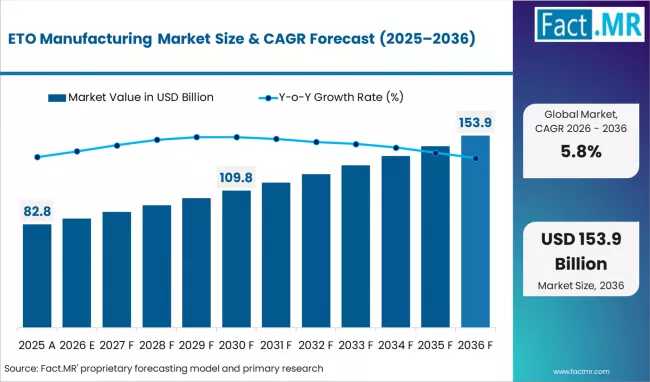
ROCKVILLE, MD, UNITED STATES, March 18, 2026 /EINPresswire.com/ -- For decades, the manufacturing world lived by the creed of repeatability and mass production. Today, that script is being flipped. As industrial environments become more hyper-specific, the demand for systems designed around unique operating constraints—rather than standard part numbers—is fueling a structural transformation in global production logic.According to a comprehensive strategic outlook by Fact.MR, the ETO (Engineer-to-Order) Manufacturing Market was valued at USD 82.8 billion in 2025. The sector is now on a steady climb, projected to reach USD 87.6 billion in 2026 and nearly double to USD 153.9 billion by 2036, expanding at a compound annual growth rate (CAGR) of 5.8%.
This growth signifies a fundamental shift: in the modern industrial economy, value is no longer just in the product—it is in the engineering that makes that product fit a precise, complex environment.
Get Access Report Sample : https://www.factmr.com/connectus/sample?flag=S&rep_id=14576
The Death of the "Standard Box": Drivers of Customization
The move toward ETO manufacturing is being driven by a refusal among top-tier industrial buyers to accept standard, one-size-fits-all equipment. Whether it is a subsea energy module or a high-throughput packaging line, today’s capital goods must be optimized for site-specific footprints, stringent local compliance, and seamless digital integration.
Key catalysts defining this transition include:
Hyper-Customization Demand: Buyers are increasingly mandating systems tailored to their specific throughput and integration constraints, viewing "standard" as a compromise on efficiency.
Rising Project Complexity: The transition to hybrid energy systems, advanced aerospace assemblies, and automated process lines requires a project-based logic that repetitive manufacturing cannot fulfill.
Digital Transformation (CPQ & PLM): The emergence of advanced Configure-Price-Quote (CPQ) and Product Lifecycle Management (PLM) tools has finally allowed manufacturers to manage the "complexity tax" that previously eroded ETO margins.
The Rise of Modular Customization: 2026 Segmental Analysis
One of the most significant takeaways from the current market data is the shift toward Modular Custom Systems, which are expected to hold a 37.2% share of order types by 2026. This represents the "practical middle ground" of modern manufacturing—reusing engineered modules to control costs while still adapting the final build to the customer’s specific requirements.
From a vertical perspective, Industrial Machinery and Equipment continues to lead, projected to command 30.6% of the industry vertical share in 2026. This sector serves as the primary home for ETO models, where factory machinery must be engineered around specific factory floor conditions and process flows.
Regional Powerhouses and Scale Dynamics
While large enterprises currently dominate demand with a 48.3% share, digital enablement is rapidly leveling the playing field for specialized mid-sized manufacturers. Geographically, the market remains a global affair:
North America and Europe: Focus remains on high-complexity, high-compliance sectors like Aerospace and Energy.
Asia Pacific: Rapid industrial modernization is driving demand for custom automation and process systems.
Middle East & Africa: Large-scale infrastructure and energy projects continue to rely on build-to-spec engineered assemblies.
The Competitive Landscape: Connecting Sales to the Shop Floor
Competitive advantage in the ETO space is no longer built on product features alone; it is built on execution infrastructure. The manufacturers winning the largest programs are those who have connected their engineering configuration directly to their procurement and production scheduling.
Key players currently shaping the ETO landscape include Krones, GEA Group, ANDRITZ, Alfa Laval, Wärtsilä, Siemens Energy, FLSmidth, SPX FLOW, John Cockerill, and thyssenkrupp Uhde. Strategic investments by leaders like Krones and Alfa Laval into standardized module libraries have set a new benchmark, allowing them to offer "engineered" results with the lead times previously associated only with configured-to-order products.
Analyst Insights: Industrializing the Variation
"The ETO manufacturing market grows exactly where customers refuse to buy a standard box," says Shambhu Nath Jha, Principal Consultant at Fact.MR. "The winners are manufacturers that can industrialize customization without letting engineering rework destroy their margin or delivery reliability. The best operators have learned that the answer is not to fight the variation, but to standardize the process of managing it."
Strategic Outlook: The Road to 2036
The next decade of ETO manufacturing will be defined by the ability to make "engineering variation" repeatable. As manufacturers move toward modular platforms and project-business digitalization, the "complexity tax" will transform into a "customization premium." For investors and executives, the opportunity lies in manufacturers who treat operational excellence as their primary strategy—ensuring that every custom build is as commercially disciplined as a mass-produced one.
Browse Full Report – https://www.factmr.com/report/eto-manufacturing-market
To View Related Report:
Ketone Supplements Market https://www.factmr.com/report/ketone-supplements-market
Blood Ketone Meter Market https://www.factmr.com/report/blood-ketone-meter-market
Phenylketonuria Treatment Market https://www.factmr.com/report/phenylketonuria-treatment-market
Diabetic Ketoacidosis Treatment Market https://www.factmr.com/report/diabetic-ketoacidosis-treatment-market
S. N. Jha
Fact.MR
+1 628-251-1583
email us here
Legal Disclaimer:
EIN Presswire provides this news content "as is" without warranty of any kind. We do not accept any responsibility or liability for the accuracy, content, images, videos, licenses, completeness, legality, or reliability of the information contained in this article. If you have any complaints or copyright issues related to this article, kindly contact the author above.
