

Europe Renewable Energy Market Projected to Reach 2,540 GW by 2035, Growing at 7.9% CAGR
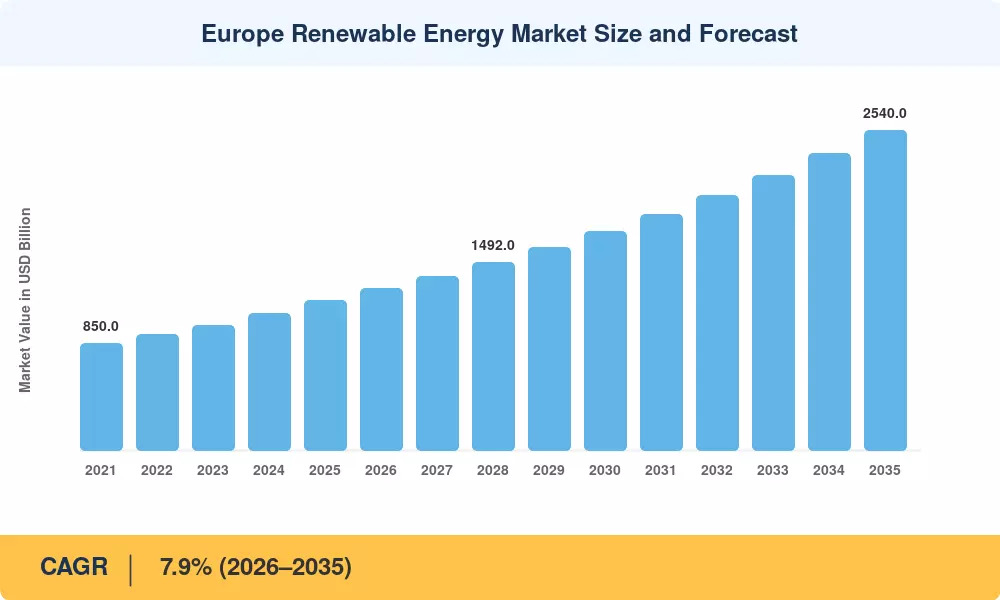
Europe Renewable Energy Market
Europe Renewable Energy Market is projected to grow from 1,282 GW in 2026 to approximately 2,540 GW by 2035, registering a CAGR of 7.9%
As Per the MRFR Analysis, Europe Renewable Energy Market is projected to grow from 1,282 GW in 2026 to approximately 2,540 GW by 2035, registering a CAGR of 7.9% during the forecast 2026 to 2035”
NEW YORK, NY, UNITED STATES, August 24, 2026 /EINPresswire.com/ -- As Per the MRFR Analysis, Europe Renewable Energy Market is projected to grow from 1,282 GW in 2026 to approximately 2,540 GW by 2035, registering a CAGR of 7.9% during the forecast 2026 to 2035, driven by Advancements in energy storage technologies.— Prashant Hake
Market Overview
The Europe Renewable Energy Market is undergoing a transformative expansion, driven by the convergence of binding regulatory mandates, declining technology costs, and accelerating corporate demand for clean power. The market encompasses installed capacity across solar energy, wind energy, hydropower, bioenergy, geothermal, and ocean energy, serving utilities, commercial and industrial end-users, and residential consumers.
This expansion is anchored in the European Commission's binding target of at least 42.5% renewable share in gross final energy consumption by 2030, backed by over EUR 210 billion in public and private investment commitments made between 2022 and 2024 alone [1]. The policy architecture underpinning this trajectory makes the Europe Renewable Energy Market one of the most structurally supported clean energy buildouts globally. The revised Renewable Energy Directive (RED III) compels member states to accelerate permitting, designate renewable acceleration areas, and guarantee grid connection timelines for approved projects, with infringement procedures for non-compliant states providing a structural policy floor [1].
A generational shift is underway across Europe's power sector. Coal-fired plants that once supplied over 25% of the continent's electricity are being decommissioned at an accelerating rate, replaced by utility-scale solar farms, onshore and offshore wind arrays, and increasingly by hybrid installations that pair generation with battery storage [4]. The European Investment Bank committed EUR 36 billion to climate-related projects in 2023, channeling capital directly into the infrastructure displacing legacy thermal assets [2]. Advances in energy storage technologies, including grid-scale battery systems, pumped hydro storage, and emerging long-duration storage solutions, are critical enablers of this transition, allowing for greater penetration of variable renewable sources by smoothing output and enhancing grid stability.
Technology investment across the Europe Renewable Energy Market is reshaping deployment patterns. Solar module prices in Europe fell below EUR 0.12 per watt in late 2024, a 40% decline from 2022 peaks, unlocking residential and small-commercial segments previously uneconomic without subsidies [4]. Floating offshore wind technology is opening vast deep-water sites in the Atlantic, Mediterranean, and Norwegian continental shelf, with over 250 GW of technically exploitable floating potential across Europe [12]. Hybrid renewable-plus-storage projects are emerging as the dominant project architecture for new capacity tenders across Spain, Italy, and Germany, improving grid dispatchability and reducing curtailment [7].
Germany commands the largest share of the Europe Renewable Energy Market, accounting for roughly 24% of total installed capacity thanks to its Energiewende program and aggressive solar rooftop mandates [6]. Spain holds the second-largest capacity share at approximately 16%, leveraging its solar irradiance advantage and streamlined permitting reforms [5]. The Netherlands is the fastest-growing country market with a projected CAGR of 10.2%, driven by offshore wind expansion in the North Sea. By 2035, cumulative capacity additions across Europe are expected to exceed 1,250 GW of new installations, with wind energy projected to grow at a 9.4% CAGR and solar maintaining its dominant capacity share [8].
📍 Get Free Sample Report for Detailed Market Insights:
https://www.marketresearchfuture.com/sample_request/21637
Market Segmentation
By Technology
The Europe Renewable Energy Market is segmented into Solar Energy, Wind Energy, Hydropower, Bioenergy, Geothermal, and Ocean Energy. Solar Energy dominates with an estimated 38% share of total installed capacity in 2025, driven by distributed rooftop and utility-scale photovoltaic deployment across southern and central Europe [4]. Germany, Spain, and Italy together account for over 60% of the continent's solar base, with distributed rooftop installations adding 15–20 GW annually.
Wind Energy — combining onshore and offshore segments — is the fastest-growing technology at a projected CAGR of 9.4% through 2035, supported by North Sea and Baltic Sea project pipelines [8]. Offshore wind alone is projected to grow from approximately 35 GW in 2025 to over 110 GW by 2035, with the Esbjerg Declaration (2022) and the Ostend Declaration (2023) collectively pledging 300 GW of offshore wind by 2050 across nine European nations [12]. Hydropower retains a stable capacity base of approximately 235 GW, primarily concentrated in Nordic countries and the Alpine region, with pumped storage playing an increasingly critical role in grid balancing [3]. Bioenergy, geothermal, and ocean energy represent smaller but strategically important segments, with geothermal growing at a 6.2% CAGR for district heating applications [11].
By End-User
The Europe Renewable Energy Market serves Utilities, Commercial and Industrial (C&I), and Residential end-users. The Utilities segment accounts for the largest share, representing roughly 62% of installed capacity as large-scale generation projects dominate procurement through competitive auction mechanisms [6]. National energy companies and independent power producers drive the bulk of capacity additions, with Ørsted, Iberdrola, and RWE collectively operating or developing over 45 GW of European renewable capacity.
Commercial and Industrial end-users are expanding at a CAGR of 8.7%, with corporate power purchase agreements (PPAs) driving on-site and near-site installations [10]. Corporate renewable energy procurement surged past 15 GW of contracted volume in Europe during 2024, up from just 3 GW in 2019, as technology firms, automotive manufacturers, and consumer goods companies sign 10–15 year fixed-price agreements that de-risk developer financing. The Residential segment accounts for approximately 12% of capacity, driven by rooftop solar adoption and feed-in tariffs, with mandatory solar requirements on new buildings in Germany, France, and Austria accelerating deployment [6].
By Geography
The Europe Renewable Energy Market analysis covers key country markets including Germany, Spain, France, Italy, the United Kingdom, the Netherlands, Denmark, Sweden, and the Rest of Europe. Germany leads with a capacity share of approximately 24%, followed by Spain at 16%, the UK at 14%, Italy at 11%, and France with an 8.1% CAGR through 2035. The Netherlands is projected to register the highest country-level CAGR of 10.2% between 2026 and 2035, driven by ambitious offshore wind targets and green hydrogen infrastructure development [8].
🛒 You can buy this market report at:
https://www.marketresearchfuture.com/checkout?currency=one_user-USD&report_id=21637
Regional Analysis
Germany
Germany commands the largest share of the Europe Renewable Energy Market at approximately 24% of total installed capacity, driven by its Energiewende program and aggressive solar rooftop mandates. Germany's Renewable Energy Sources Act (EEG) amendments target 80% renewable electricity by 2030, requiring annual solar additions of 22 GW and onshore wind additions of 10 GW [6]. Solar capacity reached approximately 145 GW installed in 2025, while onshore wind is growing at a 6.8% CAGR through 2035, supported by a 2% federal land allocation target. The federal government's designation of priority areas and streamlined permitting for wind repowering are critical to meeting these volumes. Germany's position reflects both its early-mover advantage and the scale of its industrial electricity demand, with the EEG 2023 allocating roughly EUR 28 billion in annual feed-in premiums through 2028 [6].
United Kingdom
The United Kingdom holds approximately 14% of the Europe Renewable Energy Market, with offshore wind accounting for 38% of UK capacity and solar growing at a 9.8% CAGR through 2035 [8]. The UK government's target of 50 GW of offshore wind by 2030 anchors the country's renewable strategy, with the Contracts for Difference (CfD) auction mechanism—now in its sixth allocation round—proving effective at driving down strike prices and guaranteeing investor returns [17]. Scotland's abundant wind resources and reformed planning framework continue to attract significant developer interest, while onshore wind comprises approximately 22% of UK capacity.
Spain
Spain holds the second-largest capacity share at approximately 16% of the Europe Renewable Energy Market, leveraging its solar irradiance advantage and streamlined permitting reforms. Spain added a record 8.4 GW of solar PV capacity in 2023, driven by competitive tender pricing below EUR 25/MWh and some of the highest solar irradiance levels in Europe [5]. Solar PV accounts for approximately 52% of national capacity, while onshore wind represents 28 GW installed with significant repowering upside. Hybrid projects co-locating storage are growing at a 12.3% CAGR, and the country's PNIEC 2030 plan targets 81 GW of wind and solar combined, positioning Spain as the continent's second-largest renewable market by installed base [5].
France, Italy, and Nordic Markets
France is accelerating offshore wind with six major projects totaling 8 GW in development along its Atlantic and Channel coasts, pursuing a nuclear-renewable complementarity strategy [8]. Italy is leveraging agrivoltaic systems—solar panels integrated with agricultural land—to overcome land use constraints and targets 50 GW of solar by 2030. Denmark's energy island project in the North Sea and Sweden's onshore wind buildout for industrial electrification (7.5% CAGR) round out the Nordic contribution. The Netherlands leads Europe in offshore wind ambition relative to its size, targeting 21 GW by 2030, with a 10.2% CAGR making it the fastest-growing country market [8].
Rest of Europe
Poland, Romania, and the Czech Republic collectively hold less than 6% of Europe's installed renewable capacity despite representing over 15% of the continent's electricity demand [3]. EU cohesion funds, the Recovery and Resilience Facility, and declining technology costs are converging to unlock rapid deployment in these underpenetrated markets through 2035. Poland's first offshore wind projects in the Baltic Sea, coupled with Romania's onshore pipeline, represent the most significant near-term capacity additions in Central and Eastern Europe.
Competitive Landscape / Key Players
The Europe Renewable Energy Market exhibits low market concentration, consistent with a fragmented competitive structure. The top five players collectively hold an estimated 18–24% of installed capacity, with the remaining share distributed across hundreds of regional developers, municipal utilities, and independent power producers [14]. Key players include Vestas Wind Systems, Siemens Energy (Siemens Gamesa), Ørsted, Enel Green Power, Iberdrola, EDP Renewables, RWE Renewables, Vattenfall, Statkraft, TotalEnergies Renewables, Engie, and SSE Renewables [14].
Vestas Wind Systems leads with an estimated 4–6% revenue share, offering onshore and offshore wind turbines and service contracts as the global wind turbine leader with a European manufacturing base [8]. Siemens Energy (Siemens Gamesa) follows with 3–5% share as the dominant offshore turbine supplier for North Sea projects. Ørsted holds 3–5% share as the world's largest offshore wind developer, with green hydrogen integration [22]. Iberdrola commands 3–5% share as a Spanish utility with a major UK and European portfolio. RWE Renewables holds 3–4% share as a German utility pivoting from coal to renewables [23].
Strategic developments in the industry include Ørsted's September 2024 announcement of a final investment decision on the 2.9 GW Hornsea 3 offshore wind project in the UK—Europe's largest single offshore wind farm upon completion—signaling continued commitment to the Europe Renewable Energy Market despite rising capital costs [22]. RWE completed acquisition of Con Edison Clean Energy Businesses and redirected EUR 15 billion in capital expenditure toward European offshore wind and solar projects through 2030 [23]. Iberdrola commissioned the 476 MW Baltic Eagle offshore wind farm in Germany in June 2024, its first German offshore project [8].
Latest Industry News & Developments
Ørsted (September 2024): Announced final investment decision on the 2.9 GW Hornsea 3 offshore wind project in the UK—Europe's largest single offshore wind farm upon completion—signaling continued commitment to the Europe Renewable Energy Market [22].
European Commission (November 2023): Adopted the Wind Power Package, introducing measures to accelerate permitting, improve auction design, and strengthen European wind turbine supply chains against rising import competition [15].
RWE (March 2024): Completed acquisition of Con Edison Clean Energy Businesses and redirected EUR 15 billion in capital expenditure toward European offshore wind and solar projects through 2030 [23].
Iberdrola (June 2024): Commissioned the 476 MW Baltic Eagle offshore wind farm in Germany, its first German offshore project, expanding its European footprint beyond Iberia and the UK [8].
European Investment Bank (February 2024): Approved EUR 4.2 billion in financing for cross-border renewable energy and grid infrastructure projects across six EU member states [2].
Market Challenges & Opportunities
Challenges
The Europe Renewable Energy Market faces several notable challenges. Grid congestion and curtailment represent a significant restraint, with Germany alone curtailing over 8 TWh of renewable electricity in 2023 due to bottlenecks between the wind-rich north and industrial south [9]. Transmission system operators estimate that EUR 580 billion in grid investment is required across the EU by 2030 to accommodate planned capacity additions.
Permitting delays and local opposition pose another constraint, with average permitting timelines for onshore wind projects in France and Italy still exceeding four years, compared to under 18 months in Denmark [15]. Supply chain bottlenecks, with European wind turbine manufacturers reporting order backlogs exceeding 18 months for offshore-grade nacelles and high-voltage transformer lead times stretching to 36 months, create project delays [16]. Rising interest rates and financing costs, along with land use constraints and biodiversity mandates, further challenge market growth.
Opportunities
Significant opportunities exist in the Europe Renewable Energy Market. Floating offshore wind commercialization opens vast deep-water sites with over 250 GW of technically exploitable floating potential across Europe [12]. Hybrid renewable-plus-storage projects are emerging as the dominant project architecture for new capacity tenders across Spain, Italy, and Germany, improving grid dispatchability and reducing curtailment [7]. Green hydrogen production scale-up creates a parallel demand channel for solar and wind installations, with electrolyzer deployment projected to reach 17.5 GW by 2030 under the EU Hydrogen Strategy [14].
Energy-as-a-service and digital platforms, including virtual power plants and AI-optimized asset management, are monetizing data from distributed installations [19]. Central and Eastern European capacity catch-up represents a significant growth corridor, with EU cohesion funds and the Recovery and Resilience Facility unlocking rapid deployment in underpenetrated markets. Advancements in energy storage technologies, including grid-scale batteries and long-duration storage solutions, are critical enablers for integrating higher shares of variable renewable energy, and companies developing innovative storage solutions are well-positioned to capture value.
To explore more market insights, visit us at:
https://www.marketresearchfuture.com/reports/europe-renewable-energy-market-21637
Final Market Summary
The Europe Renewable Energy Market is poised for substantial growth, projected to expand from 1,282 GW in 2026 to approximately 2,540 GW by 2035, at a CAGR of 7.9%. This expansion is fundamentally underpinned by binding EU regulatory mandates, declining technology costs, and accelerating corporate PPA demand, with advancements in energy storage technologies serving as a critical enabler for higher renewable penetration. Germany maintains its dominant position, while the Netherlands emerges as the fastest-growing country market, driven by offshore wind expansion. Technological innovation, including floating offshore wind commercialization, hybrid renewable-plus-storage projects, and green hydrogen integration, is reshaping the competitive landscape, enabling operators to address grid integration challenges and unlock new value streams. The market's long-term potential remains exceptionally strong, supported by the convergence of decarbonization policy, electrification of transport and heating, and emerging opportunities in digital energy services and Central European capacity catch-up, ensuring Europe's renewable energy buildout remains a structural investment theme through 2035 and beyond.
More Related Reports from MRFR Library:
Thermal Energy Storage Market: https://www.marketresearchfuture.com/reports/thermal-energy-storage-market-2401
Critical Power and Cooling Market: https://www.marketresearchfuture.com/reports/critical-power-cooling-market-2473
Jackup Rigs Market: https://www.marketresearchfuture.com/reports/jackup-rigs-market-2634
Surge Protection Devices Market: https://www.marketresearchfuture.com/reports/surge-protection-devices-market-2773
Battery Market: https://www.marketresearchfuture.com/reports/battery-market-2930
Offshore Decommissioning Market: https://www.marketresearchfuture.com/reports/offshore-decommissioning-market-2993
Diesel Generator Market: https://www.marketresearchfuture.com/reports/diesel-generator-market-3001
Offshore Wind Market: https://www.marketresearchfuture.com/reports/offshore-wind-market-3284
Gas Engines Market: https://www.marketresearchfuture.com/reports/gas-engines-market-3345
Oil Gas Storage Market: https://www.marketresearchfuture.com/reports/oil-and-gas-storage-market-3935
Larry Wilson
WantStats Research And Media Pvt. Ltd.
+ +1 855-661-4441
email us here
Visit us on social media:
LinkedIn
Facebook
YouTube
X
Legal Disclaimer:
EIN Presswire provides this news content "as is" without warranty of any kind. We do not accept any responsibility or liability for the accuracy, content, images, videos, licenses, completeness, legality, or reliability of the information contained in this article. If you have any complaints or copyright issues related to this article, kindly contact the author above.
